The best way to store vinyl records is vertically, in inner and outer sleeves, at 65 to 70 degrees Fahrenheit with 40 to 50 percent relative humidity, away from direct sunlight and heat sources. That is the short answer. The long answer is that vinyl, unlike most modern media, is a physical object that slowly reacts to its environment. Temperature, pressure, moisture, and gravity are all working on your collection whether you notice or not. Store records the wrong way, and they warp within months. Store them properly, and they will outlive you.
This guide covers everything you need to know about vinyl record storage: the principles, the sleeves, the climate, the furniture, and the mistakes that destroy collections. Whether you have 20 records or 2,000, the rules are the same.
You just spent money on records. Protect them. And if you are building your collection, start with a record store near you.
The Golden Rules of Vinyl Storage
Four principles drive everything else. Get these right and the details take care of themselves.
1. Vertical, always
Records must be stored upright, like books on a shelf. Never lay them flat, never let them lean at an angle, never stack them on top of each other. Flat storage compresses the grooves in the bottom records under the weight of the stack. Leaning records warp into a curve within weeks. Vertical is the only safe position.
2. Snug, not crushed
Records should stand close enough that they support each other without tipping, but loose enough that you can slide one out with gentle resistance. Packed too tight, the sleeves scuff and the covers bend. Packed too loose, records lean and warp. The right tension is like a well-organized bookshelf.
3. Away from heat and sunlight
Vinyl softens at around 100 degrees Fahrenheit and starts to warp. Direct sunlight through a window can easily push a record past that threshold, especially in a sunny room during summer. Keep records away from windows, radiators, HVAC vents, and electronics that generate heat.
4. Sleeved, always
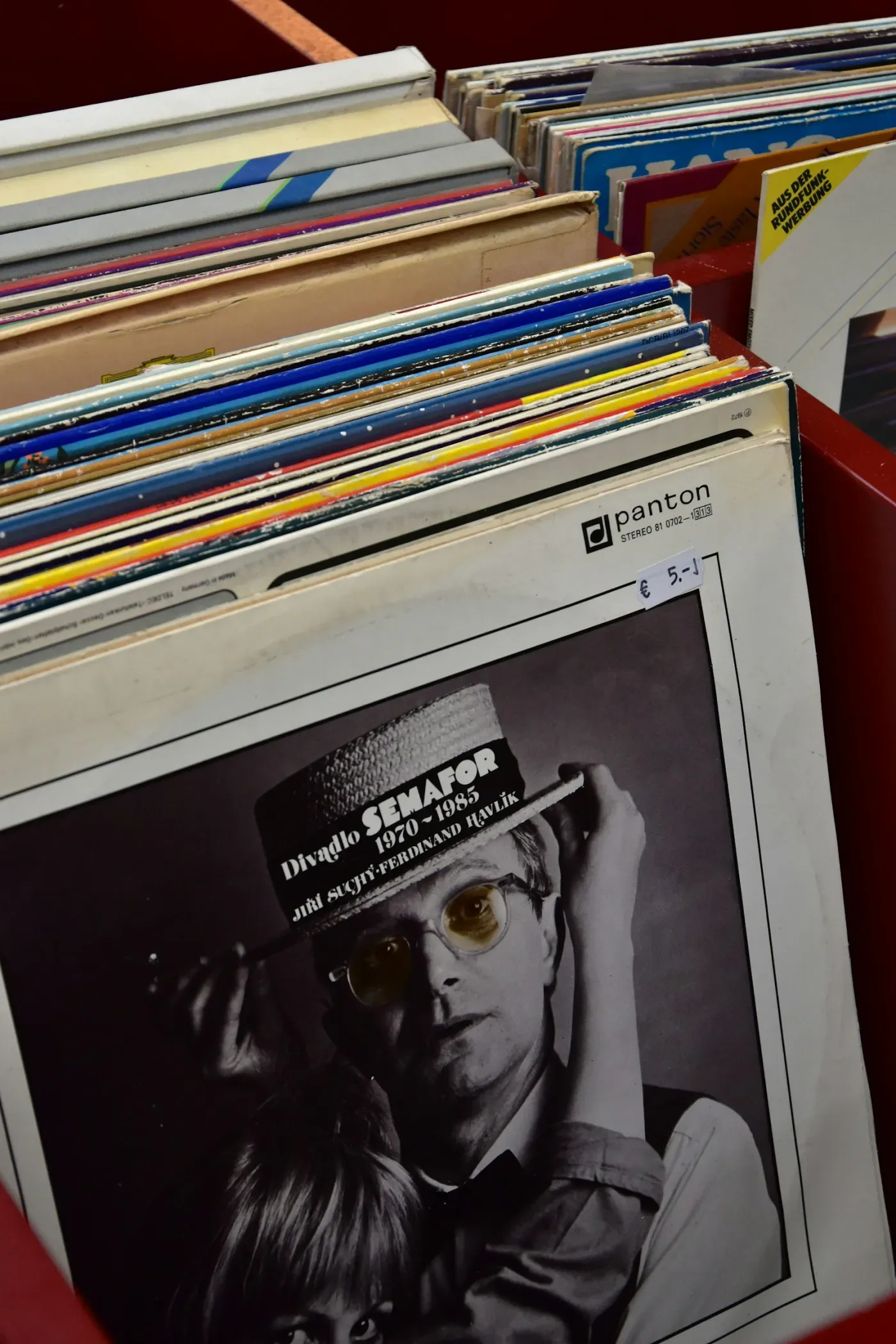
Every record should have two layers of protection: an inner sleeve around the vinyl itself, and an outer sleeve around the jacket. Without sleeves, dust accumulates in the grooves and covers get scuffed every time you pull them off the shelf.
Pro Tip
If you only do one thing after reading this guide, replace your paper inner sleeves. The paper sleeves that come with most records shed fibers that end up embedded in the grooves. Rice paper or polyethylene sleeves cost pennies per record and save your collection.
Inner and Outer Sleeves: What to Buy
This is where most collectors get tripped up. Not all sleeves are equal, and some are actively bad for vinyl.
Inner sleeves
The inner sleeve is what touches your vinyl. Three options, ranked worst to best:
- Paper sleeves (bad). The paper sleeve that came with the record. Fiber shedding, abrasion, acid over time.
- Rice paper sleeves (good). Acid-free paper with a polyethylene liner. Archival-grade. Inexpensive. What most collectors use. Sleeve City rice paper sleeves are the standard, usually around 15 dollars per 50.
- Polyethylene or HDPE sleeves (best). Clear plastic sleeves, no abrasion, no acid, zero fiber shedding. Slightly more expensive. The gold standard. Mobile Fidelity MoFi Master Inner Sleeves are what most archival collectors use.
Avoid PVC inner sleeves. PVC plasticizers can leach onto vinyl over decades and cause surface damage. Stick to rice paper or polyethylene.
Outer sleeves
The outer sleeve wraps around the jacket. It protects the cover from scuffs, ring wear, dust, and humidity.
- Polypropylene (clear, the best choice). Crystal-clear, acid-free, durable. 3-mil or 4-mil thickness is standard. Sleeve City and Vinyl Storage Solutions both carry them in 3-mil and 4-mil.
- Polyethylene. Less clear, slightly softer. Also fine.
- PVC. Avoid. Can yellow and leach plasticizers.
Buy outer sleeves in bulk. A pack of 100 polypropylene outer sleeves costs around 20 dollars. Sleeve every record in your collection once, and you never worry about jacket damage again. If your local record store sells them, buy there and support the shop.
Find a Record Store Near You
Browse every brick-and-mortar record store in the U.S. by state and plan your next dig.
Browse the Record Store DirectoryTemperature, Humidity, and Sunlight
Vinyl is polyvinyl chloride, a thermoplastic. It softens when warm, hardens when cold, and expands and contracts with temperature changes. The enemy is not a single hot day. The enemy is repeated swings that slowly deform the record.
Temperature: 65 to 70 degrees
Room temperature is ideal. Records can tolerate a range from about 40 to 80 degrees Fahrenheit without issue, but extended exposure above 85 degrees causes warping and above 100 causes permanent deformation. Avoid attics (summer heat), garages (freeze-thaw), and any location that spikes during the day.
Humidity: 40 to 50 percent
Too dry, and paper covers become brittle. Too humid, and mold grows on the jackets. A cheap hygrometer (around 10 dollars, Turntable Lab carries them alongside their cleaning gear) tells you what your storage area is actually doing. If you live somewhere humid, run a dehumidifier. If you live somewhere arid, a humidifier helps preserve cover board integrity.
Sunlight: avoid entirely
UV light fades cover art and heats vinyl. A sunny window can hit 120 degrees on a surface in summer. Store records away from windows, or use curtains that block sunlight during peak hours.
Common Mistake
Storing records in a car for "just a few hours" in summer. Interior car temperatures routinely exceed 140 degrees in direct sun. Records warp permanently within 30 minutes. If you bought records on a road trip, bring them inside immediately.
Shelving and Storage Furniture
The shelf matters as much as the sleeves. Records are heavy (a pound each, give or take), and a sagging shelf leans records into each other, which warps them.
IKEA Kallax
The most popular vinyl storage solution in the world, and for good reason. Each cube holds approximately 70 standard 12-inch LPs with room to flip through. The shelf is strong enough to support a fully loaded 4x4 cube (over 1,000 records total) without sagging. Available in 1x4, 2x4, 4x4, and 5x5 configurations direct from IKEA.
Dedicated vinyl cabinets
Brands like Vinyl Storage Solutions, Way Basics, and Symbol Audio make cabinets sized specifically for 12-inch vinyl. More expensive (100 to 600 dollars, Symbol Audio runs into the thousands) but built for the job.
Wire cube grid shelves
The cheap college-student solution. Works in a pinch, not ideal long-term because wire shelves can mark the bottoms of jackets.
Wooden shelves
Any bookshelf with solid wood or 3/4-inch MDF shelving, no sag, adjustable height. Check for sag with a straight edge before loading records.
How much does a full Kallax weigh?
A fully loaded 4x4 Kallax holds around 1,100 records and weighs roughly 1,200 pounds. Secure it to the wall. Always.
5 Storage Mistakes That Ruin Records
- Stacking flat. The single fastest way to warp a record. Gravity is patient.
- Leaning storage. A shelf with gaps where records lean sideways. They warp into whatever shape they are forced into.
- Paper sleeves. Fibers embed in grooves. Switch to rice paper or polyethylene.
- Direct sunlight. UV fade, surface heat, warping. Move the shelf away from the window.
- Unconditioned garages and attics. Summer heat warps, winter cold cracks sleeves. Climate-controlled spaces only.
Storing 7-Inch Singles and 10-Inch Records
LPs are the default, but most collectors accumulate 7-inch singles and the occasional 10-inch release. The rules scale.
7-inch records
Use dedicated 45 rpm boxes or dividers. Stored upright, sleeved the same way (paper jacket plus polyethylene or polypropylene outer). Bags Unlimited makes archival 45 mailers, storage boxes, and dividers. Sleeve City carries 7-inch inner and outer sleeves in every thickness.
10-inch records
These fall between sizes and are often sold in custom jackets. Use 10-inch outer sleeves and store them on a shelf deep enough to hold them without overhang.
Long-Term Archival Storage
If you are storing records for more than a few years in a space you do not regularly use (a second home, a storage unit, a basement archive), a few extra steps protect against slow environmental damage.
- Climate-controlled storage unit. Yes, it costs more. Yes, it is worth it.
- Silica gel packs in bins. Absorb ambient humidity.
- Archival boxes for long-term storage. Acid-free, lignin-free cardboard boxes from Gaylord Archival or Bags Unlimited.
- No basement concrete floor contact. Put records on a pallet or shelf. Concrete wicks moisture.
- Check once a year. Open boxes, inspect for mold, rotate if needed.
Ready to Add to Your Collection?
Find independent record stores in every state across the U.S.
Browse Record Stores Near YouGet More Vinyl Tips
Storage, cleaning, collecting tips, and record store news, delivered to your inbox.
Vinyl Record Storage FAQ
Take care of the records. They will outlive you.