A vinyl record is a physical copy of a sound wave. Not a digital representation, not a compressed file, not a sampled snapshot. The groove on your LP is a continuous spiral whose shape is the same shape as the air pressure variations that went into a microphone years or decades ago. When the stylus rides that groove, it reproduces the original motion, a cartridge converts motion to voltage, and the chain ends at your speakers.
The whole thing is mechanical. That is the single most important fact about vinyl. No code, no sampling, no reconstruction. The bumps in the groove are a 1:1 analog of what the microphone heard. This guide walks through how vinyl records actually work at every stage: the cutting lathe that creates the groove, the stereo 45-degree geometry that puts two channels on one needle, the RIAA curve that makes the format practical, and the physics of why a plastic disc can store music at all.
From Studio to Stamper: How a Record Gets Made
A commercial LP goes through a multi-stage process before it hits the shop:
- Mastering. The final mixed audio is mastered specifically for vinyl. Bass may be checked for mono compatibility. Loudness is adjusted to fit groove space. Dynamics are usually preserved better than on streaming masters.
- Cutting the lacquer. A mastering engineer feeds the audio into a cutting lathe, typically a Neumann VMS-70 or Scully. The lathe drives a heated cutting stylus that carves a groove into a blank lacquer disc. This is the original physical copy of the audio.
- Plating. The lacquer is electroplated into a negative master, then a positive mother, then multiple negative stampers. The stampers are what actually press records in production.
- Pressing. A hot puck of vinyl (PVC) is placed between two stampers in a press. Heat and roughly 100 tons of pressure squeeze the vinyl into the groove shape, with a paper label pressed into the center at the same moment.
- QC, sleeving, shipping. Test pressings are played for defects. Production pressings go into inner sleeves, jackets, and shrink-wrap.
The entire mechanical chain from microphone to stamper preserves the analog waveform. The only conversion to digital (if any) happens during mastering if the source was recorded or mixed digitally. A fully analog record, traced from a 1970s master tape through a modern lathe, never sees a bit.
The Groove Itself
The groove is the entire magic. A standard 12 inch LP at 33 1/3 RPM carries roughly 1,500 feet of groove per side wound into a single spiral. The groove walls are shaped like a V, tilted 45 degrees from vertical, and the stylus sits at the bottom of the V.
Two properties of the audio map to two properties of the groove:
The groove-to-sound translation
Louder sound = wider side-to-side deflections in the groove wall. The stylus swings further side to side during playback.
Higher frequency = more deflections per unit length. Tighter wiggles packed closer together.
Silence = a smooth groove with no deflection. The stylus rides straight down the middle.
You can actually see this under a microscope. A bass note cuts big smooth curves in the groove. A hi-hat cuts thousands of tiny sharp wiggles. A quiet passage is a nearly glass-smooth trench. Loud passages need more physical space, which is why engineers can only fit around 22 to 24 minutes of loud music on one side of a 12 inch LP, while spoken-word LPs can push 30 minutes per side.
How Stereo Grooves Work
Stereo records use a clever geometric trick called the 45/45 system, introduced by Westrex in 1957 and adopted industry-wide by 1958. Instead of two separate grooves for left and right channels, a single groove is cut with the left channel modulating one 45-degree wall and the right channel modulating the other 45-degree wall.
The stylus has two independent axes of motion. It can swing horizontally and vertically. Horizontal motion is the sum of both channels (mono information). Vertical motion is the difference between them (stereo information). A cartridge with coils oriented to pick up both motions reads both channels out of one physical groove.
This is why mono records and stereo records can play on the same turntable. A mono groove has only horizontal modulation. A stereo cartridge reads it and sends identical signal to both channels, giving you a correct centered mono image.
The Stylus and Cartridge
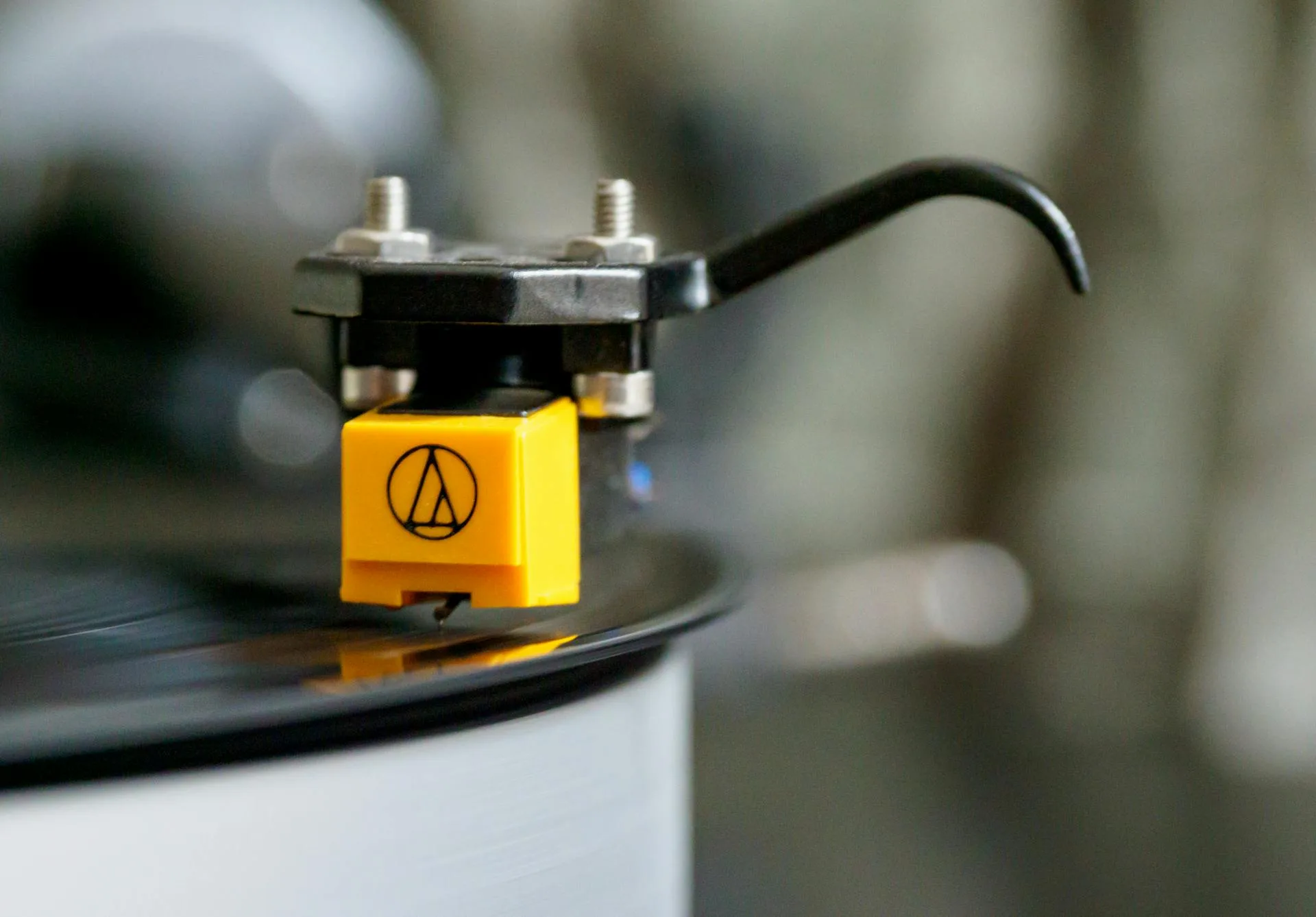
The stylus is the tip of the needle, almost always a diamond mounted on a cantilever. Diamond is used because it is hard enough to resist wear from thousands of hours of groove contact. The shape of the diamond matters:
- Conical (spherical). Cheapest. Traces the groove like a ball in a trough. Good enough for starter turntables, wears fastest.
- Elliptical. Two radii. Longer contact area on the groove wall, better high frequency tracing, less wear. The standard for mid-range cartridges.
- Hyperelliptical / line contact / Shibata / microline. Exotic shapes that trace the groove like a blade rather than a point. Best performance, highest cost, most fragile.
The cartridge is the housing that converts stylus motion into electrical signal. Two main types:
- Moving magnet (MM). Magnets on the cantilever move inside fixed coils. Higher output, easier to set up, swappable stylus. Most entry and mid-level turntables use MM.
- Moving coil (MC). Coils on the cantilever move inside fixed magnets. Lower mass, better tracking, lower output (usually needs a step-up transformer). High-end rigs use MC.
Both types rely on the same principle: changing magnetic flux induces voltage in a coil. The stylus moves, the cartridge generates a tiny AC signal that mirrors the groove shape, and that signal leaves the cartridge on its way to the preamp.
Tonearm, Preamp, Speakers
Between the cartridge and your speakers, the signal passes through several stages:
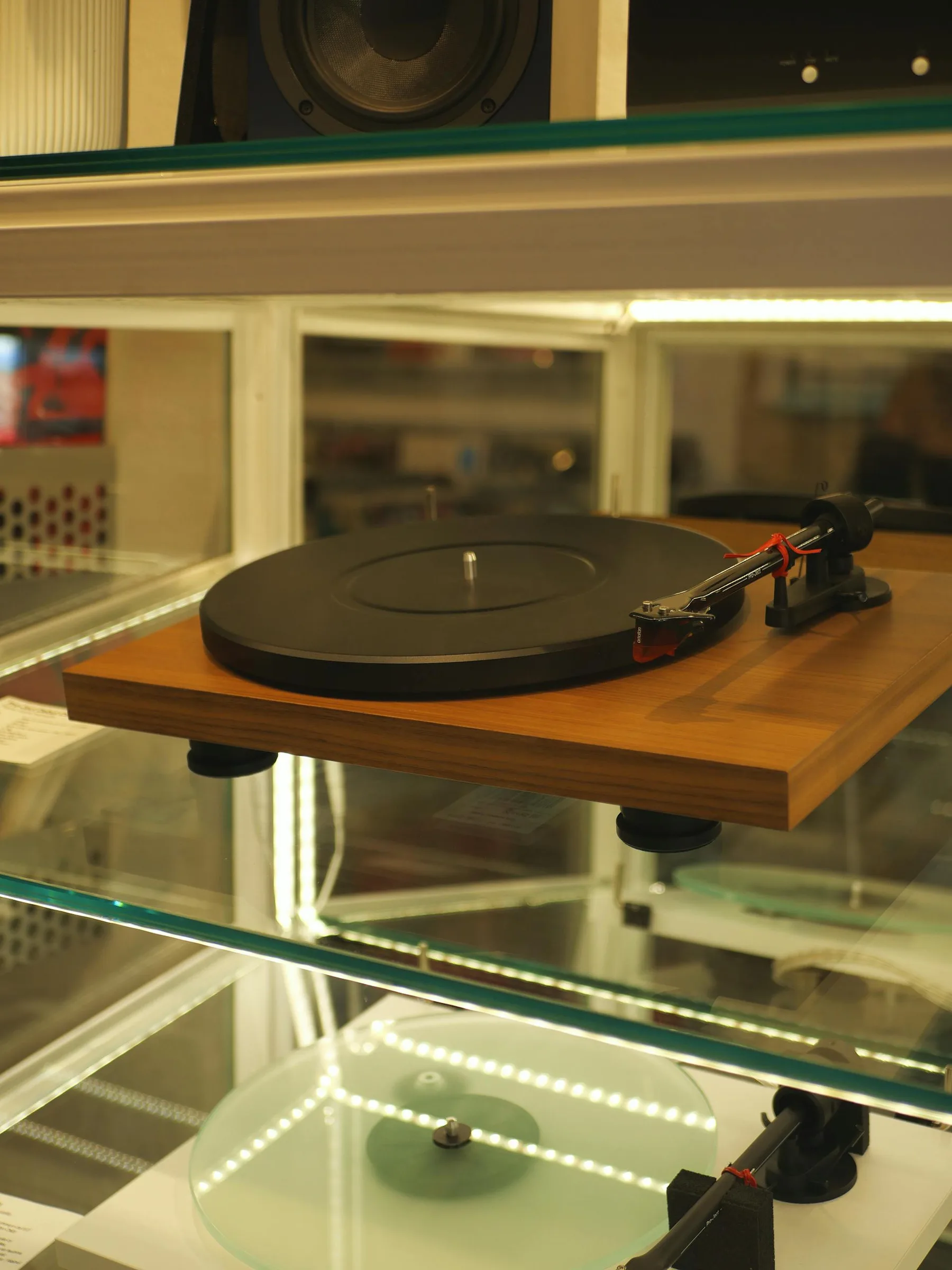
- Tonearm. Holds the cartridge, tracks the groove across the record, and applies a specific downward force (tracking force, usually 1.5 to 2.5 grams). The tonearm also has anti-skate to counteract the inward pull a spinning record applies to the needle.
- Phono preamp. The cartridge output is tiny (a few millivolts for MM, a fraction of a millivolt for MC) and frequency-skewed. The phono preamp amplifies it to line level and applies the inverse RIAA curve to restore correct frequency balance. Some turntables have a built-in preamp, others require an external one or an amplifier with phono input.
- Amplifier. Standard line-level amplification from there. Integrated amp or separate pre/power, your choice.
- Speakers or headphones. The amplified signal moves a voice coil, which moves a cone or driver, which moves air, which reaches your ear. That air motion is (ideally) the same shape as what the microphone captured, passed through a long mechanical and electrical chain and arriving as sound.
The RIAA Curve
If you cut a record exactly as the music sounds, it would not work. Bass frequencies would take huge amounts of groove space, and treble would be masked by surface noise. In 1954 the RIAA (Recording Industry Association of America) standardized an equalization curve that fixes both problems.
RIAA equalization in two sentences
On cutting: bass is reduced and treble is boosted before the groove is cut. This makes grooves narrower (more music per side) and pushes the music above the noise floor.
On playback: the phono preamp applies the exact inverse curve. Treble is reduced back to normal, bass is restored to normal. The result sounds correct.
Every record made since the late 1950s follows this curve. If you route a turntable through a line input instead of a phono input, you hear the pre-corrected signal: thin, bright, no bass. That is the uncorrected RIAA curve leaking through. It is also why you cannot skip the phono preamp stage. Without it, vinyl sounds broken.
Why Vinyl Sounds Like Vinyl
People argue about whether vinyl sounds better than digital. That argument is taste. What is not argued is that vinyl sounds different, and the differences are predictable:
- Dynamic range. Theoretical dynamic range of vinyl is around 70 dB, compared to CD's 96 dB. In practice mastering for vinyl is often less compressed than mastering for streaming, so vinyl can feel more dynamic despite a narrower ceiling.
- Noise floor. There is always some surface noise. Even a pristine pressing has audible groove rush and dust pickup. Clean records are very quiet, not silent.
- Bass treatment. Stereo bass below 150 Hz is often summed to mono during cutting to prevent the needle from jumping out of the groove. The result is centered, focused low end.
- Treble limitations. The highest frequencies lose fidelity toward the inner groove, where the groove velocity is lowest. Running time on the inner 25% of a side is always the weakest audio.
- Distortion profile. Vinyl distorts gracefully. When it clips, it sounds warm rather than harsh. Digital clips differently and sharper.
The sum of those traits is what listeners describe as "warm," "lively," or "organic." It is not nostalgia or placebo. It is a measurably different frequency, noise, and distortion profile compared to a 16-bit PCM file.
What Actually Damages Records
Records are durable but they are not indestructible. The main threats:
- Heat. Warps vinyl permanently. A record left in a car on a hot day is probably dead. See our vinyl storage guide for safe temperature ranges.
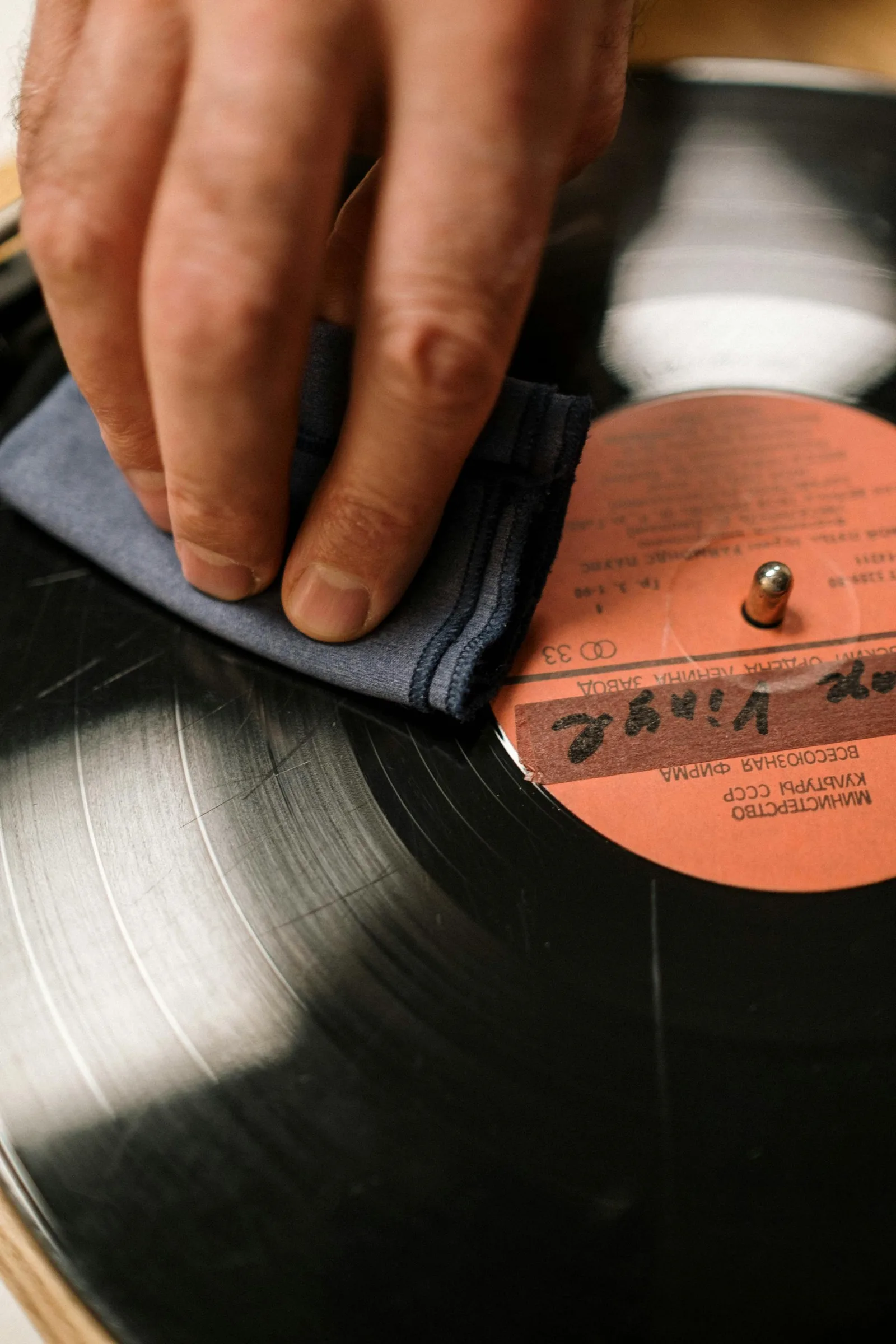
- Dust. Grinds into grooves during play and increases wear dramatically. Clean records before every side. A carbon fiber brush takes 10 seconds.
- Worn stylus. A damaged or worn-down stylus cuts new grooves on top of the original ones. Replace around 500 to 1,000 hours depending on cartridge.
- Scratches. Permanent and cannot be fixed. Handle records by edges and labels only.
- Sunlight. Fades sleeves and warps discs over months. Store vertically in a cool, dry, dark room.
- Static. Attracts dust. An anti-static brush or cleaning mat helps. Humidity control matters in dry climates.
Store Your Collection the Right Way
Temperature, humidity, and shelving all matter. Our vinyl storage guide covers the basics.
The Best Way to Store Vinyl RecordsWhere to buy stylus replacements and cleaning gear: Turntable Lab stocks cartridges, replacement styluses, and cleaning kits across every budget. Acoustic Sounds carries audiophile cartridges and cleaning machines. Sleeve City is the go-to for archival inner and outer sleeves. Your local independent record store will also usually carry basics. See our U.S. record store directory to find one.
More Vinyl 101 Content
Explainers, storage guides, and the physics of the format, delivered to your inbox.
FAQ
A groove, a diamond, a coil, a wave. That is vinyl, all the way down.